
 Security
Access with a purpose
Plan permissions, secret handling, and environment boundaries around the needs of the project.

Strategy, design, and engineering in one connected process. Software shaped around the problem you need to solve.
Engineering teams in the Factory reference
Factory materials — temporary reference















Product thinking and engineering, connected. Every stage has a purpose. Every technical decision starts with what the project actually needs.
Start with the product goals, user needs, and technical constraints. Turn them into a clear, practical delivery plan.
 Claude
 Gemini
 Grok
 Kimi
 DeepSeek
 Mistral
 GPTGPT-OSS
 GLM
 Qwen
 Llama
Design, implementation, validation, and release belong to one connected workflow. Context stays with the team at every step.
Modular architecture and readable code make room for the next version, the next integration, and the next business goal.





Managed infrastructure and services
Cloud services connected to private systems
Infrastructure in your own environment
Environments with restricted network access
One connected delivery process. Select a stage to explore the work and the outputs it brings to the project.

Understand the goal, the people, and the scope of the first meaningful release.

Connect the system architecture with a considered user experience.

Work in focused iterations, with visible progress and regular review.

Check the functionality, the integrations, and the readiness to release.

Use feedback to shape the next useful improvement to the product.
Explore the disciplines behind a considered digital product.
DOCS Connect requirements, priorities, and the next stages of your product.
DOCS Clear, accessible interfaces built around real user journeys.
DOCS Web applications, mobile experiences, and services working as one system.
DOCS Connect tools, processes, and information through dependable interfaces.
DOCS Review behaviour, performance, accessibility, and the critical paths.
 DOCS
Prepare environments, delivery pipelines, and the next product iteration.
DOCS Map dependencies, technical constraints, and the decisions that will shape the next release.
 DOCS
Improve an existing system in manageable steps, keeping its business context visible.
 DOCS
Build accessible, responsive interfaces with a clear structure and dependable performance.
 DOCS
Connect mobile user journeys to the services and workflows behind them.
 DOCS
Make builds and releases repeatable, with checks at the points that matter.
 DOCS
Bring logs, errors, and product signals together to guide the next improvement.
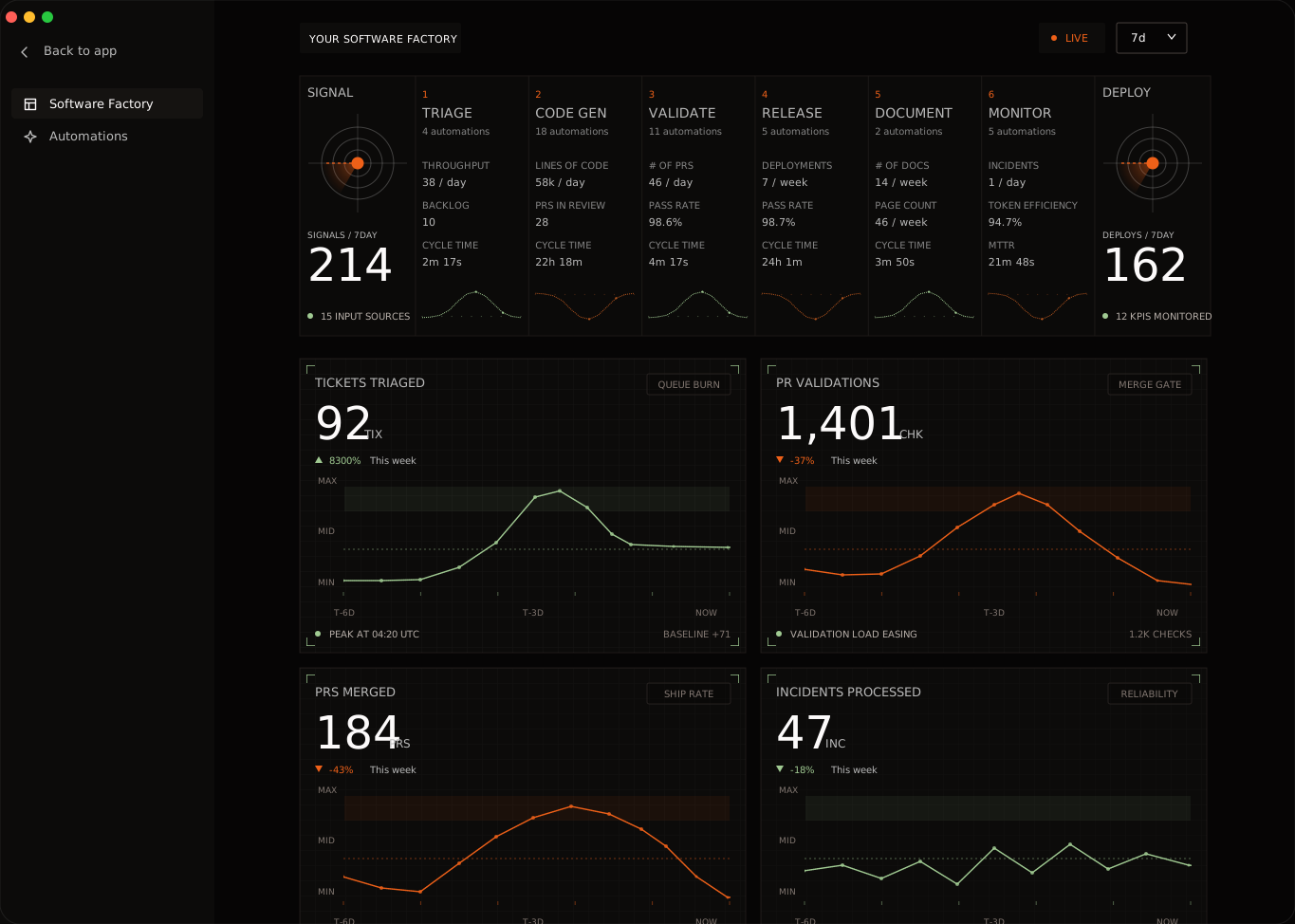
The Factory reference tracks delivery time, reliability, and cost. These sample indicators illustrate the dashboard layout.
Factory materials — temporary referenceTime between an incoming task and its production release.
The proportion of completed work delivered without manual intervention.
Typical time from a reported incident to an available fix.
How long released code stays unchanged in the example system.
Model usage cost measured against merged pull requests.
 Trust and control
Delivery works best when access, review, and ownership are considered from the beginning.
SecurityPlan permissions, secret handling, and environment boundaries around the needs of the project.
GovernanceAgree on review rules, release checks, and responsibilities before they become blockers.
EnablementDocument the workflow, share context, and give the team a practical route into the new system.
A telecom example combines generated tests and security checks across 400 microservices.
Major telcoA financial services example uses automated first-pass reviews to surface compliance issues earlier.
Global financial servicesIn this SaaS example, 30% of incidents are resolved before an engineer is paged.
Enterprise SaaSA healthcare technology example reports three consecutive audits without compliance findings.
Healthcare techComarch describes faster development and improved accuracy with Droid in its engineering workflow.
ComarchBegin with a focused challenge or connect the whole delivery process. The next step should be clear, practical, and useful for your team.